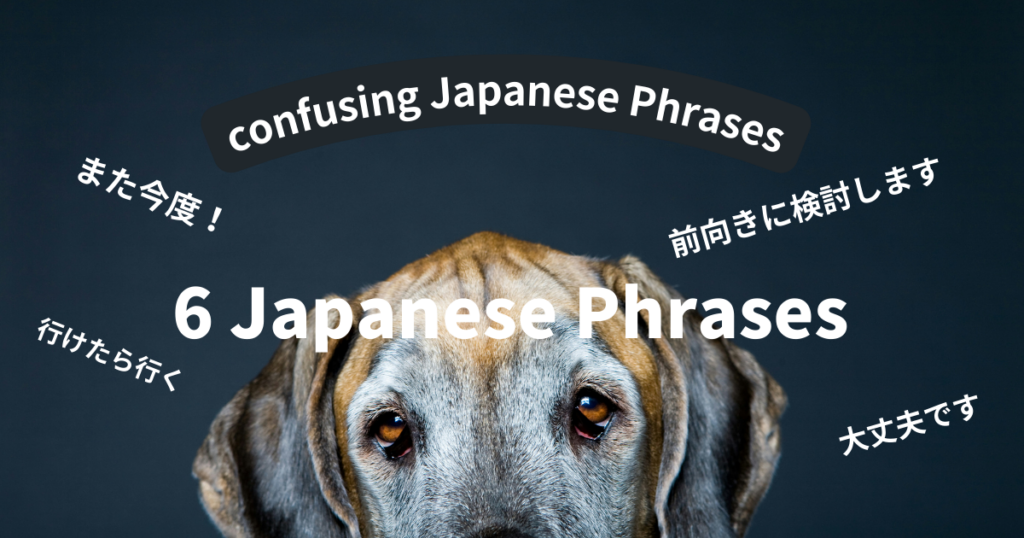
Japanese is a fascinating language, but sometimes the words people say and what they actually mean are slightly different.
In daily conversations, Japanese people often use indirect expressions to avoid hurting someone’s feelings or sounding too direct. Because of this, the real meaning of a phrase can depend heavily on the situation.
Interestingly, even people born and raised in Japan sometimes find these expressions confusing.
Today, I’d like to introduce six Japanese phrases that often confuse Japanese learners.
How many of them do you already know?
1. 「大丈夫(だいじょうぶ)です」
Literal meaning: It’s okay / I’m fine
However, this phrase can have several different meanings depending on the situation.
Example
Store clerk: Do you need a bag?
Customer: 大丈夫(だいじょうぶ)です。
In this case, it means:
“No, thank you.”
But in another situation:
Friend: How are you feeling?
Me: 大丈夫(だいじょうぶ)です。
Here it means:
“I’m fine.”
So the exact meaning depends on context.
2. 「行(い)けたら行(い)く」
Literal meaning: If I can go, I’ll go.
In reality, many Japanese people use this phrase to mean:
“I probably won’t go.”
Saying 「行きません」 (I won’t go) directly can sometimes sound a little cold in Japanese culture.
So instead, people soften the response by saying:
行(い)けたら行(い)く
If you invite a Japanese friend and they say this,
it might be wise not to expect them too strongly.
3. 「また今度(こんど)(会(あ)おう)」
Literal meaning: Let’s meet next time.
However, this does not always mean there is an actual plan to meet again.
Sometimes it is simply a polite way to end a conversation.
Of course, sometimes people genuinely mean it. But if the person never contacts you again to make a plan, it might just be a polite expression.
4. 「それは難(むずか)しいです」
Literal meaning: That is difficult.
But in Japanese, this phrase is often used to mean:
- “I can’t do that.”
- “That’s not possible.”
Rather than saying できません (I can’t do it) directly, Japanese people often use それは難しいです as a softer way to refuse something.
So in many cases, it doesn’t mean
“It’s difficult but I’ll try.”
It often means
“It’s difficult, so I can’t do it.”
5. 「前向(まえむ)きに検討(けんとう)します」
This phrase is commonly used in business situations in Japan.
Literal meaning:
“We will consider it positively.”
However, it can mean two different things:
• We will genuinely consider it
• We are politely declining
Because of this ambiguity, even Japanese people sometimes wonder what it really means.
6. 「全然(ぜんぜん)できません」
Literal meaning: I can’t do it at all.
However, Japanese people often say this as a form of humility.
Example
A: Your Japanese is amazing!
B: 全然(ぜんぜん)できません。
In reality, the person might genuinely not be able to speak well.
However, the opposite can also happen. Sometimes even people who speak very fluently use this phrase.
Because of this, the real meaning often depends on the situation and context.
Is Japanese a “Reading the Air” Language?
In Japanese communication, people often value:
- being considerate of others
- avoiding overly direct statements
- reading the atmosphere (空気(くうき)を読(よ)む)
Because of this, understanding Japanese requires more than just grammar and vocabulary.
Context, tone, and situation are also very important.
You already need to learn hiragana, katakana, and kanji…
and on top of that, you sometimes need to read the atmosphere too.
No wonder Japanese can feel like a complex language!
Final Thoughts
Did you ever think:
“Why don’t people just say exactly what they mean?”
Honestly, sometimes even Japanese people think that too.
But this kind of ambiguity is also part of Japanese culture.
How many of these phrases did you already know?
If there are other Japanese expressions that made you think
“Wait… what does that actually mean?”please share them!
I hope this article helps you understand Japanese communication a little better.
See you next time!